
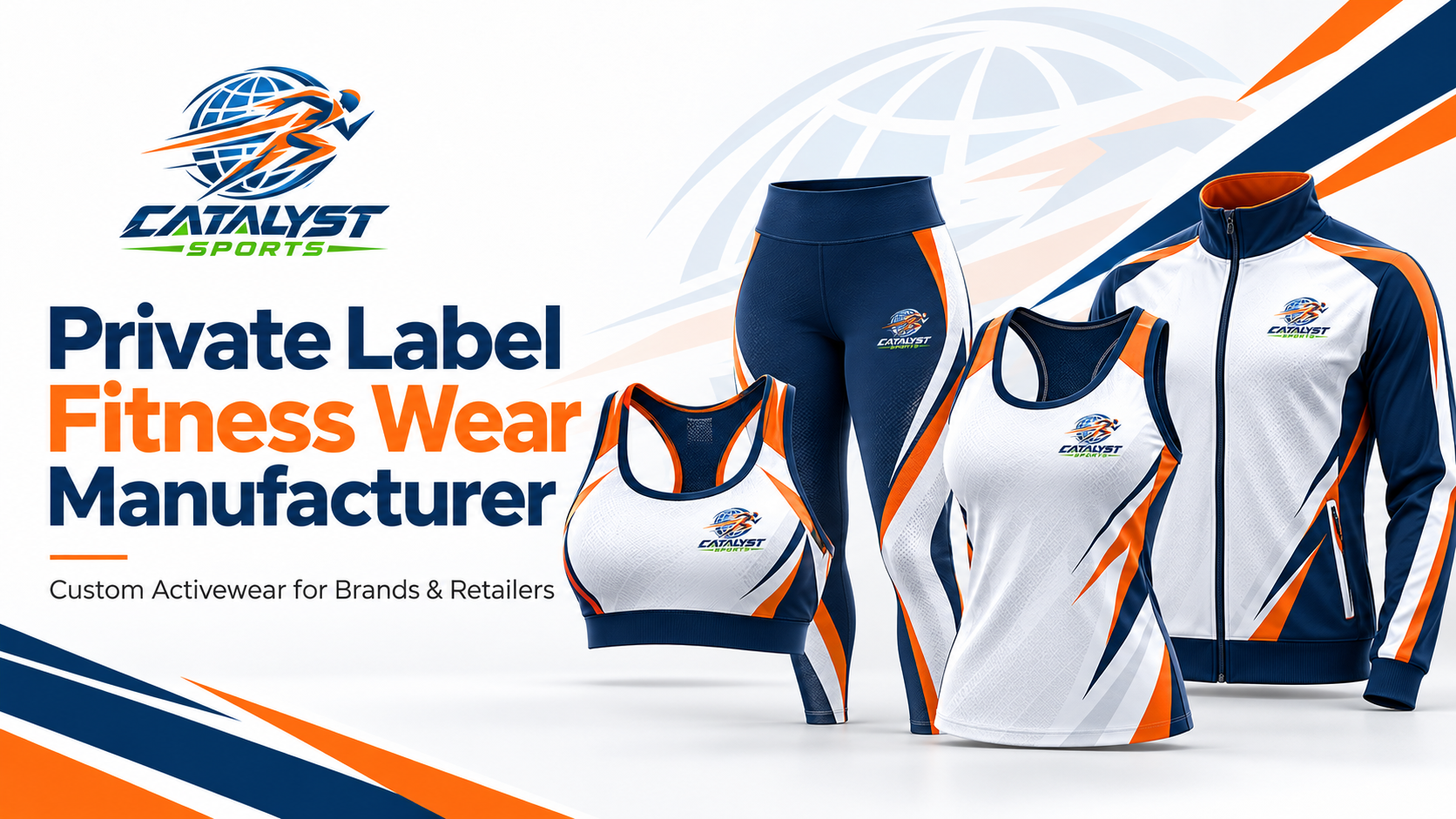
Launching a fitness clothing brand involves several important decisions. Beyond creating an attractive logo or selecting fashionable colors, businesses need to consider fabric performance, garment fit, product quality, manufacturing costs, and customer expectations.
Working with a private label fitness wear manufacturer allows entrepreneurs and established retailers to develop clothing collections under their own brand identity.
Instead of depending entirely on generic products, businesses can create customized sports bras, leggings, compression garments, gym shirts, tank tops, and matching fitness sets designed for their target audience.
At Catalyst Sports, we support private-label apparel development through custom manufacturing solutions for fitness businesses, activewear brands, retailers, and wholesale buyers.
What Is Private Label Fitness Wear?
Private label fitness wear refers to athletic clothing produced by a manufacturer for sale under another company’s brand.
Depending on the manufacturing arrangement, the clothing may be developed from customer-provided designs or customized according to selected patterns, fabrics, colors, sizes, and branding requirements.
For example, an activewear startup may want to introduce a collection containing high-waisted leggings, matching sports bras, and fitted training shirts.
A private-label manufacturer can work with the company to determine the required garment specifications and production arrangements.
This approach gives businesses greater control over the identity and presentation of their clothing collections.
Why Private Label Activewear Is Attractive to Clothing Brands
Build a Distinctive Brand Identity
One of the biggest advantages of private-label manufacturing is the opportunity to establish a recognizable clothing brand.
Businesses can develop coordinated products featuring selected colors, labels, packaging, and design details.
Instead of competing exclusively on price, brands can differentiate themselves through product styling, fit, quality, and their intended customer experience.
Create Products for a Specific Audience
Fitness clothing customers have different preferences.
Some prioritize flexible yoga apparel, while others want gym clothing suited to strength training, running, or general athletic activities.
Private-label development helps businesses create collections for particular activities and customer groups.
A yoga-focused brand, for instance, may prioritize flexible fabrics and comfortable waistbands.
A training apparel company may concentrate on durable garment construction, practical fit, and suitable fabric performance.
Maintain Better Control Over Product Specifications
When developing private-label products, buyers can communicate their expectations regarding material selection, garment measurements, stitching, branding, and finishing.
Well-defined specifications help manufacturers understand the intended result and give businesses a clearer basis for product evaluation.
Essential Products for a Fitness Wear Collection
Creating a successful fitness clothing range starts with choosing products that match the needs of your audience.
Custom Sports Bras
Sports bras are an important category in women’s activewear.
Design requirements can vary depending on the intended activity, desired support level, fabric construction, and customer preferences.
Important development considerations include shoulder strap configuration, band construction, lining, coverage, and stretch recovery.
A product’s actual support characteristics should be evaluated through suitable fit and wear testing rather than assumed from its appearance.
Fitness Leggings
Leggings are widely used for gym workouts, yoga, training, and everyday activewear.
Popular design characteristics include high-rise waistbands, flexible fabric blends, flat seams, and practical pocket options.
Manufacturers and brands should evaluate fabric opacity, waistband comfort, measurements, and how the garment behaves during movement.
Well-planned leggings can become a core product for an activewear collection.
Compression Wear
Compression shirts, shorts, and pants are frequently included in training apparel ranges.
These garments generally use fitted patterns and stretch fabrics.
It is important to distinguish ordinary close-fitting activewear from products making specific medical or physiological compression claims.
Any technical performance claims should be supported by appropriate evidence.
Custom Gym T-Shirts and Tank Tops
Training shirts and tank tops offer versatile options for both men’s and women’s fitness apparel collections.
They can be produced in fitted, relaxed, sleeveless, or other custom styles according to the brand’s requirements.
Material weight, cut, neckline, armhole construction, and graphic placement can all influence the finished design.
Matching Fitness Sets
Coordinated fitness sets help businesses create visually consistent collections.
A matching sports bra and leggings combination, for example, provides a unified look that can be offered in multiple colors and sizes.
Consistent fabric selection and color matching are important considerations when developing sets intended to be worn together.
Running and Training Wear
Running shorts, lightweight shirts, training trousers, and layering garments can complement an existing gym wear collection.
Product development should reflect the intended activity, weather conditions, and wearer preferences.
Selecting Suitable Fabrics for Fitness Wear
Fabric selection is one of the most important decisions in activewear development.
The right material contributes to comfort, stretch, durability, and the overall feel of a garment.
Polyester-spandex blends: Commonly selected for activewear requiring flexibility, shape retention, and lightweight construction.
Nylon-spandex blends: Frequently considered for leggings, sports bras, and fitted workout apparel where softness and stretch are desired.
Cotton blends: Suitable for selected casual gym shirts, hoodies, and lifestyle-oriented fitness garments.
Technical mesh: Useful for ventilation panels and particular garment constructions.
The best fabric depends on the product’s intended purpose and specifications.
Buyers should also consider material weight, shrinkage, opacity, colorfastness, and recovery after stretching.
Requesting and evaluating samples can help brands make informed decisions.
The Importance of Fit and Sizing
An attractive fitness garment may still disappoint customers if its sizing is inconsistent.
For this reason, brands should define clear measurement specifications before production.
Important measurements can include chest, waist, hip, body length, inseam, waistband dimensions, and other product-specific details.
Sizing should be evaluated on the intended garment pattern and fabric.
A size labeled medium in one market may not match the dimensions expected by customers in another.
For international brands, a carefully planned size chart is particularly valuable.
Custom Branding for Private Label Gym Clothing
Brand presentation contributes to how customers recognize and remember a clothing company.
Private-label fitness wear can incorporate various branding details depending on the product and manufacturing requirements.
Options may include:
- Custom neck or waistband labels
- Printed brand logos
- Heat-transfer logos
- Embroidered branding on suitable garments
- Custom care labels
- Hang tags
- Branded packaging
- Coordinated collection colors
These details should be planned during product development rather than treated as an afterthought.
For activewear, branding methods should also be evaluated for comfort, flexibility, and compatibility with the selected material.
How to Prepare Your First Private Label Fitness Wear Order
A clear manufacturing brief makes product development more efficient.
Define Your Collection
Begin by identifying the products you want to introduce.
A new brand may start with a focused collection containing leggings, sports bras, gym T-shirts, and matching training sets.
A smaller, well-defined product range can be easier to coordinate than many unrelated designs.
Prepare Design References
Share sketches, photographs, technical drawings, or other visual references that communicate the intended garment.
Where possible, include measurements, fabric preferences, stitching details, branding placements, and colors.
Discuss Order Quantities
Manufacturing quantities can depend on product complexity, fabric requirements, decoration methods, and other production factors.
Ask the supplier to clarify which quantities are practical for your selected designs.
Review Product Samples
Sampling helps buyers evaluate the garment before confirming bulk production.
Check sizing, fabric feel, stitching, stretch, graphics, and finishing.
If modifications are required, communicate them clearly and confirm the final approved specifications.
Confirm Production and Shipment Details
Before production begins, clarify pricing, payment terms, lead times, packaging, quality expectations, and delivery arrangements.
Clear coordination reduces the likelihood of misunderstandings during manufacturing.
Common Mistakes to Avoid When Launching an Activewear Brand
New fitness clothing businesses sometimes focus heavily on visual design while overlooking practical product requirements.
One common mistake is selecting a fabric without evaluating how it performs in the intended garment.
Another is approving production before checking sizing and fit.
Brands may also underestimate the importance of clear product specifications, consistent colors, and appropriate branding placement.
Unrealistic delivery expectations can create additional problems, particularly when products require development or customization.
A structured product development process helps businesses address these challenges before investing in a larger collection.
Why Choose Catalyst Sports for Private Label Fitness Wear?
Catalyst Sports is a custom apparel manufacturer and exporter based in Sialkot, Pakistan.
We work with businesses seeking fitness wear, casual apparel, sportswear, and other custom clothing products developed according to their specific requirements.
Our manufacturing approach focuses on design coordination, suitable materials, garment construction, stitching quality, customization, and export preparation.
We understand that different clothing brands have different priorities.
A new business may need assistance developing its initial product range, while an established retailer may be looking to expand an existing collection.
Our objective is to coordinate a suitable manufacturing solution based on the customer’s designs, quantities, product specifications, and business requirements.
Frequently Asked Questions
Can I create fitness clothing with my own brand name?
Yes. Private-label manufacturing allows businesses to develop garments with their own approved branding, designs, and labels, subject to the agreed production requirements.
Can I customize fitness clothing colors and sizes?
Colors and sizing specifications can be discussed during product development. Available options depend on the selected design, materials, and production arrangements.
Is sampling important before a bulk order?
Sampling is particularly valuable when developing a new garment because it provides an opportunity to assess fit, fabric, design details, and construction.
Can a clothing startup work with a private label manufacturer?
Yes. Clothing startups can discuss their product requirements with manufacturers. Practical order quantities and development costs should be confirmed for each project.
Start Building Your Fitness Clothing Brand
A successful activewear business begins with a clear understanding of its customers and carefully developed products.
From fabric selection and sizing to branding and final garment construction, each decision contributes to the quality and identity of a fitness collection.
Choosing a manufacturing partner that understands customized apparel development can help turn your product concept into a practical production plan.
Ready to develop your own fitness wear collection?
Connect with Catalyst Sports through www.catalystsportsintl.com to discuss custom gym clothing, private-label activewear, sports bras, leggings, compression apparel, and wholesale fitness wear manufacturing.